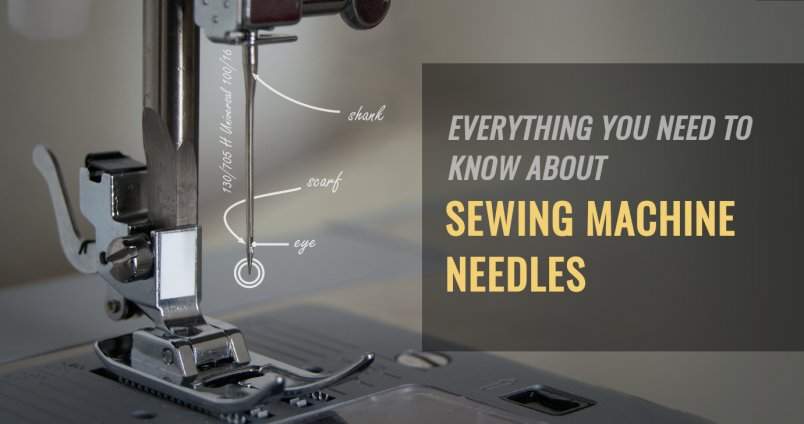
Choosing the right sewing machine needle is one of the most important, and most often overlooked, parts of any sewing project. The needle does the hard work of piercing fabric thousands of times, yet it is also one of the most delicate parts of the machine. The wrong type or size can lead to broken needles, skipped stitches, shredded thread, or uneven seams.
This guide covers sewing machine needle anatomy, needle systems, point styles, common needle types, sizing, brands, color coding, why needles break, and how often to replace them. By the end, you should be able to match a needle to your fabric and thread with more confidence, and spot when a needle is causing stitch problems.
What you need to know about Sewing Machine Needles
Here is what this guide covers:
- The main parts of a sewing machine needle
- Common needle points and when they help
- Needle types and typical uses
- American and European sizing systems
- Major needle brands and rebranded options
- How often to replace needles
- Why needles break and how to avoid it
That is a lot of ground. Let’s start with the basics.
Anatomy of a sewing machine needle
First, look at the parts of a standard household sewing machine needle.
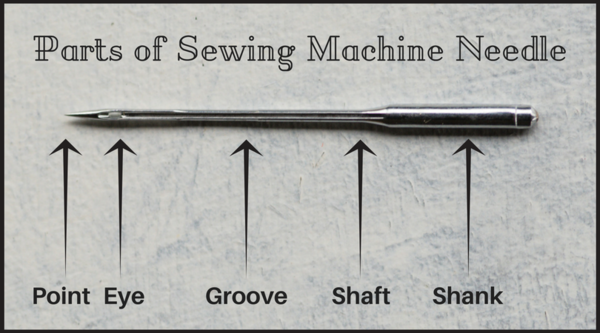
Here is a quick description of each main component:
- Butt – the top end of the needle that seats into the needle clamp when you change needles.
- Shank – the thicker upper section. On most household needles it has a flat side. Insert it into the clamp with the flat side oriented as your machine manual shows, usually facing away from you on front-loading domestic machines.
- Shoulder – the tapered section that transitions from the shank to the thinner shaft.
- Shaft/Blade – the main body of the needle between the shoulder and the eye. Shaft diameter is what needle size refers to.
- Groove – a channel on the front of the shaft that helps the thread sit close to the needle as it passes through fabric.
- Scarf – a small indentation on the back of the needle just above the eye. It gives the bobbin hook a better chance to catch the thread loop and helps reduce skipped stitches.
- Eye – the hole the thread passes through. Eye length and shape vary by needle type; specialty needles may use a longer or differently finished eye.
- Point – the tip that enters the fabric. Point shape is one of the biggest differences between needle types.
A needle looks simple, but each part has a job. Understanding those parts makes it easier to see why one needle behaves better on knits, denim, or leather than another, and it can help when you are chasing skipped stitches or broken thread.
Needle systems
Before comparing needle types, confirm the needle system. The system describes the needle’s overall design and whether it will fit your machine correctly.
Most modern household sewing machines use needles with a flat-sided shank and a scarf. That system is commonly labeled 130/705 H. The H in 705 H comes from the German word Hohlkehle, meaning “with scarf.”
If packaging says 130/705 H, the needle is usually suitable for a modern domestic machine. You may also see the system listed as 15×1 or HAx1. The system is normally printed on the box next to the needle type and size.
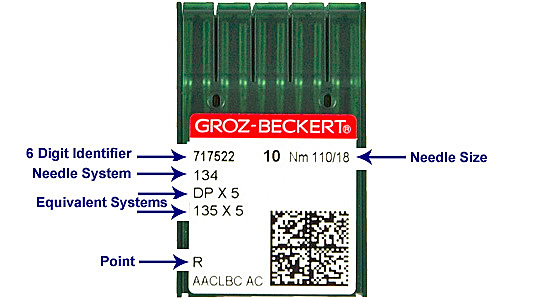
Industrial machines and some older machines may use different systems. For example, some older Bernina domestic machines take 705 B needles, which do not have a scarf. Always check your machine manual if you are unsure.
For most modern household machines, buy needles marked 130/705 H unless your manual specifies otherwise.
Needle points
The point leads the needle through the fabric. Different shapes suit different materials. Common categories include:
- Ball point – used mainly for knit fabrics. The rounded tip pushes fabric yarns aside instead of cutting through them, which helps prevent runs and holes in knits.
- Set point – sharper than a ball point and used mainly for woven fabrics, where a cleaner penetration through the weave is helpful.
- Wedge/cutting point – cuts through dense materials such as leather. For more on machines suited to that work, see our guide to sewing machines for leather.
The image below shows the differences between these needle points.

There are many variations within these groups. Ball points, for example, are often offered in light, medium, and heavy versions with different degrees of roundness. Specialty needles then combine a point style with changes to the eye, scarf, or shaft.
What are the different types of sewing machine needle?
When you choose a needle for a project, you usually make two decisions: needle type and needle size. Start with type.
Needle type should match the fabric and the kind of sewing you are doing. The table below lists common household needle types, their typical points, and when they are used. If you are new to sewing, printing a simple chart and keeping it with your machine accessories can save a lot of guesswork.
| Needle Name | Needle Point | Application |
|---|---|---|
| Universal | Light ball point | Between a sharp point and medium ball point, this is a general purpose needle which can be used for most applications without issues. |
| Jersey | Medium ball point | Used for knit fabrics, the ball point on this needle pushes the yarns apart instead of cutting through them. |
| Stretch | Medium ball point | Used for stretch materials. Similar to the Jersey needle, the ball point avoids cutting through fibers, which would be disastrous for a stretch material. The scarf on this needle is specially designed to prevent skipped stitches. |
| Sharp/Microtex | Sharp set point | The very sharp point makes this needle ideal for tightly woven fabrics including synthetic materials like polyester, silk and laminates. |
| Jeans | Sharp set point | Great for denim or densely woven fabrics. The sharp point allows the needle to penetrate these fabrics more easily. Good for heavy duty projects. |
| Metallic/Metafil | Sharp set point | Used with metallic or synthetic threads. This needle has a longer eye with a non-stick coating that helps prevent shredding and breaking of metallic thread. The larger eye is also easier to thread. |
| Embroidery | Light ball point | These needles sometimes have special coatings to help deal with the extra heat generated by the faster embroidery stitching speeds. |
| Quilting | Light ball point | A stiffer shaft and tapered needle point allow this needle to more readily penetrate several layers of fabric, which is perfect for quilting. |
| Topstitch | Sharp set point | A topstitch needle has a larger eye to accommodate heavier topstitching threads. |
| Leather | Wedge/cutting point | Leather needles have a cutting point which allows them to slice through the densely packed structure of leather. |
| Quick-threading/Self-threading | Light ball point | These needles are the same as a universal needle but have a slot into the eye which makes them much easier to thread. |
Schmetz has a useful breakdown of needle types on its site (archived copy linked).
Needle Sizes
Each needle type also comes in multiple sizes. Size does not mean needle length. Household sewing machine needles of the same system are generally the same length. Size refers to the diameter of the needle shaft.
Choosing the right needle size
Needle size matters as much as needle type. Choose size based on fabric weight and thread weight. A needle that is too large for the thread and fabric can leave oversized holes and increase skipped stitches. A needle that is too fine for dense fabric or heavy thread is more likely to bend or break. As a rule of thumb, use finer needles on lighter fabrics and heavier needles on denser fabrics, then test on scraps.
Sizing systems
Needle sizes are commonly listed in two systems: the American system (sometimes called the Singer system because Singer helped popularize it) and the European system. The European number is the shaft diameter in hundredths of a millimeter. A 90 needle is about 0.9 mm in diameter; a 110 needle is about 1.1 mm.
The table below lists common needle sizes in both systems, with typical fabric-weight guidance. Treat the fabric column as a starting point, not a hard rule for every fabric and thread combination.
| American | European | Fabric Weight |
|---|---|---|
| 20 | 120 | Very heavy |
| 18 | 110 | |
| 16 | 100 | Heavy |
| 14 | 90 | Medium |
| 12 | 80 | Light |
| 11 | 75 | |
| 10 | 70 | Fine |
| 9 | 65 | |
| 8 | 60 |
Some needle types are only sold in certain sizes. Topstitch needles, for example, are typically offered in larger shaft sizes because they are meant for heavier thread.
Top sewing machine needle brands
Only a limited number of companies manufacture household sewing machine needles. The main manufacturers commonly discussed by sewists include:
- Schmetz
- Organ
- Klasse
These sewing machine brands also sell needles under their own names. Those are often rebranded from a major needle maker:
- Singer – commonly reported as manufactured by Groz-Beckert.
- Bernina – often rebranded Schmetz needles.
- Janome – often rebranded Organ needles.
- Inspira – a needle brand associated with SVP Worldwide, which owns Singer, Pfaff, and Husqvarna Viking. These needles are often recommended for Pfaff and Husqvarna machines and are frequently described as similar to Klasse needles.
In everyday sewing, many people do not notice dramatic quality differences between reputable household needle brands when the type and size are correct.
A practical approach is to start with whatever your machine manufacturer recommends, then buy equivalent needles in bulk from the underlying maker when you want to save money. For example, Organ needles are a common bulk option for machines that ship with Janome-branded needles. Always test a new needle and thread combination on scraps before sewing the real project.
Needle color coding
Brands use different color systems, which can get confusing if you mix packs.
Here is a quick summary:
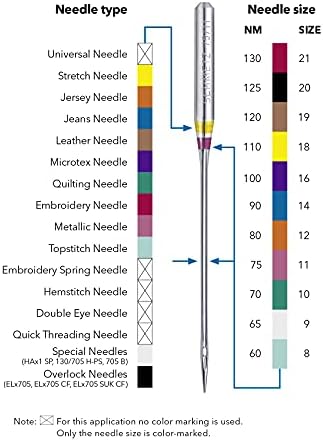
- Bernina and Schmetz needles often have two color bands on the shoulder. The top color indicates needle type and the bottom color indicates size. Singer needles are similar in idea, but the shank color often indicates type and the shoulder color indicates size. Not every needle is colored. Universal needles are often left uncolored.
- Klasse needles are commonly stamped on the shank for size and type, while the boxes are color coded.
- Janome and Organ needles are often uncolored, though some specialty needles use colored shanks. Janome’s well-known examples include blue tipped, purple tipped, and red tipped needles, usually offered in specific sizes rather than a full size range.
Why do sewing machine needles break?
A broken needle is frustrating and can be hazardous if fragments fly. Knowing common causes helps you avoid most breakages:
- Wrong needle type or size – Match the needle to the fabric and thread, and test on scraps before sewing the project.
- Pins – Hitting a pin can snap a needle or bend it so it breaks later. Remove pins before they reach the presser foot whenever possible.
- Needle not inserted correctly – Follow your machine’s needle-change instructions for orientation and insertion depth.
- Bent needle – A bent needle can strike the needle plate or presser foot. Check for bends before you sew.
- Pulling fabric – Forcing fabric through the machine instead of letting the feed dogs move it can deflect the needle and cause a strike.
- Poor maintenance – Lint under the needle plate or around the bobbin area can interfere with stitch formation and needle travel. Clean the machine regularly.
- Thread not feeding freely – If the spool catches or the machine is threaded incorrectly, excess tension can contribute to needle or thread breakage.
Whenever you install a new needle, turn the handwheel by hand to lower the needle once before sewing. That quick check confirms the needle clears the presser foot and needle plate.
How often should I replace my sewing machine needle?
Advice on replacement timing varies. Manufacturers often recommend changing needles after a set number of sewing hours:
- Singer has recommended replacing a needle every 8 to 10 hours of sewing in some guidance, and every 16 hours in this FAQ.
- Bernina has recommended replacing a needle every 4 to 6 hours of sewing.
Those numbers do not always line up, and machines sew at different speeds, so hours alone are an imperfect measure. Other rules of thumb include changing after a certain stitch count, such as around 10,000 stitches, or after a set number of bobbins. Bobbin counts are easier to track for many home sewists, even if they are still approximate.
A practical habit is to inspect the needle before every project and replace it more often than feels strictly necessary. Needles are inexpensive compared with damaged fabric, skipped stitches, or a scarred needle plate. Running a dull or bent needle as long as possible is usually a false economy.
Titanium-coated needles typically stay sharper longer than standard needles. Janome has claimed that some of its titanium-coated needles last up to about 40 hours of sewing. Even then, replace the needle if stitch quality drops, the tip looks damaged, or you hear unusual thumping or clicking.
Let’s discuss!
If this guide helped clarify needle systems, types, or replacement habits, share what works in your sewing room.
Do you have a favorite needle brand, or a tip that has saved you from broken needles? Join the conversation in the comments below.
Please can you tell me why flat sided needles for domestic machines are so much more expensive – to industrial machine needles .
Thanks
Please can you tell me why needles have a flat side AND what are the consequences of inserting the needle with the flat side forward?
Is each side of the eye different?
I have been having problems due to fitting the flat side facing me!!
Best regards
Steve from Berkshire
hello
What kind of needle did you buy?
What kind of sewing machine do you have?