Brand overview
Juki is a Japanese sewing machine brand used by both home sewists and professionals. Founded in 1945, the company is widely associated with industrial sewing equipment, but it also makes household sewing machines, quilting machines, embroidery options, and overlockers (sergers). Many sewists look to Juki for durability, straightforward operation, and reliable stitch quality, especially if they want a machine that feels closer to industrial performance in a home setting.
Where are Juki sewing machines made?
Most Juki sewing machines are manufactured in Japan, with production sites in locations including Tokyo and Kakogawa. Juki also has manufacturing facilities in other countries, including China and Thailand, to serve demand in those regions. Even so, a large share of Juki machines continue to be built in Japan.
Brief history
Juki entered the sewing industry in 1945 with a focus on home machines. The first household models appeared in 1947 and were sold in Japan and abroad. Although Juki later became a major industrial sewing machine company, its earliest machines were made for the home.
Industrial sewing machines followed in 1953, starting with simpler garment-industry models and expanding as electronics and motors improved productivity, comfort, and safety. Juki’s household-related advances include a rotary needle thread take-up system in 1954, an automated thread trimmer and auto needle threader in 1978, and an auto thread tension system in 1985. Those developments fed into new HZL models for home use.
Juki opened its first U.S. office in New York City in 1974, then moved to a larger site in Saddle Brook, New Jersey, in 1976 to handle industrial distribution (and later household overlocks). Around that period, the company introduced home overlock machines based on industrial serger technology. The Juki Lock MO-100 Series became well known for performance and longevity, and some owners still look for attachments for those original machines.
What the brand is known for
Juki is best known for industrial-grade know-how applied to both factory and home machines. On the consumer side, that often means solid straight-stitch and quilting machines, capable overlockers, and computerized sewing models aimed at sewists who want power and consistency. The brand’s reputation for durability is a common reason quilters and garment makers consider Juki when they need a machine that can handle regular, demanding use.
Product lines and machine categories
Juki makes industrial machines for garment production as well as home sewing, quilting, embroidery, and overlock machines. Linked names go to our reviews. Lineups change, availability varies by market, and some models may be older or harder to find new.
Computerized sewing machines
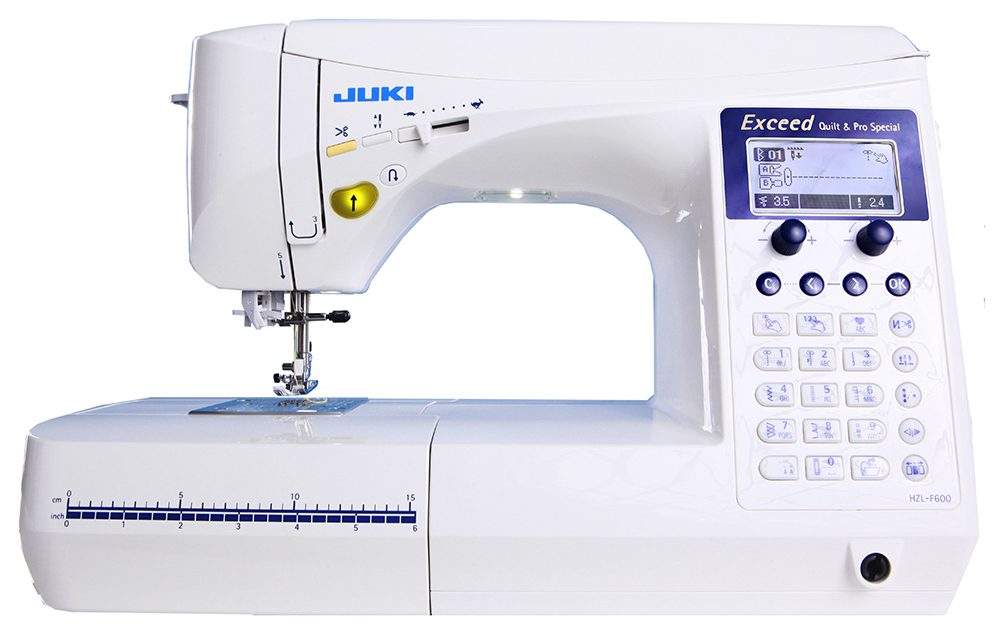
HZL computerized sewing and quilting machines for home sewists who want industrial-influenced performance with a full stitch library.
- Juki HZL-NX7 Kirei
- Juki HZL-F600
- Juki Kokochi DX-4000QVP
- Juki Sayaka DX-3000QVP
- Juki DX-2000QVP
- Juki DX-1500QVP
Quilting and large-workspace machines
TL straight-stitch quilting machines and larger QVP models popular with US quilters who want speed, a long arm, and a strong feed system.
- Juki Haruka TL-18QVP
- Juki TL-2010Q
- Juki J-150QVP
- Juki Miyabi J-350QVP
- Juki Miyabi J-350QVP S
Embroidery machines
Dedicated multi-needle embroidery options for home and small-studio use.
- Juki Tajima Sai 8 Needle Embroidery Machine
Overlockers and coverstitch machines
MO overlockers and coverstitch machines for clean seam finishes, from entry sergers to air-threading QVP models.
- Juki MO-114D
- Juki MO-104D
- Juki MO-1000
- Juki MO-2000QVP
- Juki MO-1200QVP
- Juki Akane MO-3000QVP
- Juki MO-2800
- Juki MO-80CB
- Juki MCS-1700QVP
Older and discontinued models
Earlier Juki home overlockers such as the MO-100 Series are often remembered as long-lasting machines from the brand’s push into household sergers. They are not part of the current lineup above, but they remain a reference point for sewists who still own or service older Juki overlockers. Some earlier MO-600 series models (for example MO-623, MO-644D, MO-654DE, MO-655, and MO-735) are also commonly found used rather than as current catalog machines.
- Juki MO-100 Series (discontinued)
- Juki MO-623 (discontinued)
- Juki MO-644D (discontinued)
- Juki MO-654DE (discontinued)
- Juki MO-655 (discontinued)
- Juki MO-735 (discontinued)