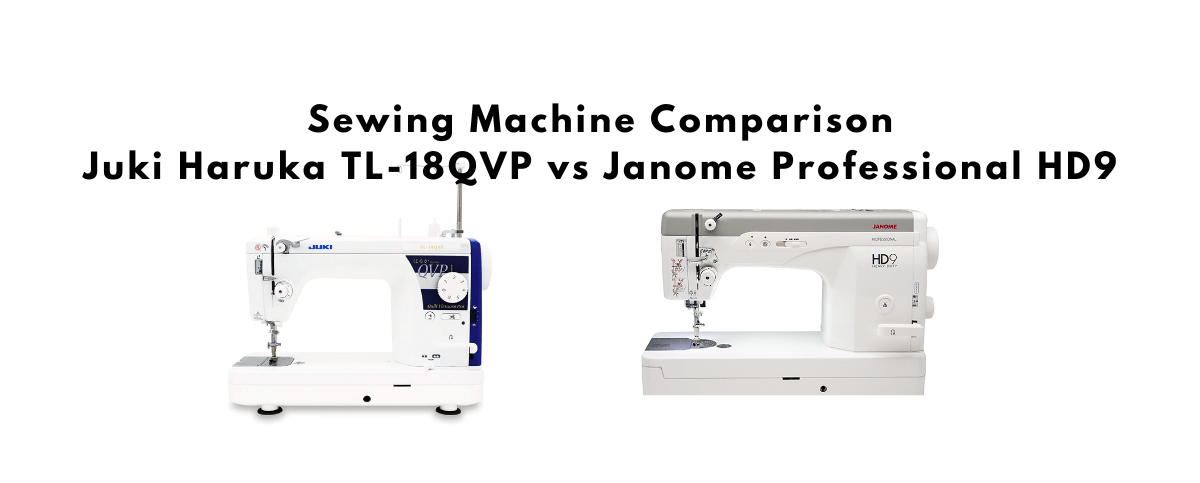
If you sew thick layers, bag parts, or do a lot of free-motion quilting, a straight-stitch-only semi-industrial machine is often a better tool than a multi-stitch home machine. Two popular options are the Janome Professional HD9 and the Juki TL-18QVP Haruka. Both come from brands with deep industrial roots: Janome and Juki. Official sites: janome.com and juki.com.
These are home-sized machines with industrial habits: straight stitch only, high speed, side-loading bobbins, and stout frames. They are not as powerful as a full industrial head, but they handle heavy sewing far better than most computerized multi-stitch machines. They also do not have a free arm, so sleeves and small tubular work are awkward.
Full reviews:


What they share
Both are aluminum-framed straight-stitch machines with automatic needle threaders, needle up/down, adjustable foot pressure, a knee lift, and a maximum stitch length of 6 mm (about 0.24 in). Both feel solid under thick fabric. The decision usually comes down to throat space versus weight, bobbin capacity, thread cutting, and whether you need drop feed for free motion.
Differences: Janome HD9 vs Juki TL-18QVP Haruka
Size and sewing space
The HD9 has a bit more throat width. The TL-18QVP is smaller overall and roughly 3 kg (about 6.6 lb) lighter, so it is easier to move to a class or rearrange in a small room. If portability matters more than maximum quilt bulk under the arm, the Juki has the edge.
| Janome Professional HD9 | Juki TL-18QVP Haruka | |
| Machine size | W 498 x H 323 x D 178 mm (19.6 x 12.7 x 7.0 in) | W 452 x H 350 x D 219 mm (17.8 x 13.8 x 8.6 in) |
| Machine weight | 14.5 kg (32 lb) | 11.5 kg (25.4 lb) |
| Work space | 225 x 140 mm (8.9 x 5.5 in) | 215 x 150 mm (8.5 x 5.9 in) |
Threading and tension
The HD9 offers two thread paths: one for standard thread and one for thicker thread. That is useful for topstitching and heavier construction thread (waxed thread is still a poor idea on these machines). The TL-18QVP includes a helpful sub-tension setup that makes it easier to keep balance across thread types. Both approach heavy thread differently. Try your favorite topstitch threads if you can demo both.
Foot control
The Juki TL-18QVP foot control includes a heel-kick thread cut, which is excellent when you chain-piece or free-motion and want to keep your hands on the work. On the Janome, thread-cut foot control is typically an optional add-on rather than standard. The Janome pedal is oversized and comfortable. If built-in heel-kick cutting matters to you, the Juki wins this round.
Sewing speed
Speeds are close: about 1,600 spm on the HD9 and about 1,500 spm on the TL-18QVP. Both have speed sliders so you can sew slowly with control. For most home quilting and bag making, either is fast enough. The limiter matters more than the headline number.
Bobbin system
Both load bobbins from the side. The HD9 can use larger jumbo bobbins with roughly 40% more thread capacity, which means fewer bobbin changes on long quilting sessions. It also has a separate bobbin-winding motor so you can wind while sewing. The TL-18QVP uses standard bobbins and does not have that independent winder. If you hate stopping to rewind, the Janome advantage is real.
Drop feed
On the Juki, you can drop the feed dogs with a lever for free-motion quilting and free-hand embroidery. The HD9, as commonly configured for this comparison, does not offer the same drop-feed convenience. Quilters who free-motion often should weigh that carefully.
Price
Street prices move with kits and sales. Soft US pricing for both often lands in a similar band, commonly around the mid $1,000s depending on retailer and bundle. The HD9 has sometimes been a bit less expensive than the TL-18QVP at MSRP in some markets, but check current US listings rather than old currency conversions. Both are widely sold online and through dealers.
Summary
Both machines are strong straight-stitch workhorses for quilting, bags, and thick materials. Neither has a free arm, so they are the wrong primary machine for lots of sleeves and cuffs. Prefer the Janome HD9 for slightly more throat space, jumbo bobbins, and winding while you sew. Prefer the Juki TL-18QVP Haruka for lower weight, heel-kick thread cutting, and drop feed for free motion. You can do excellent work on either. Match the extras to how you sew.